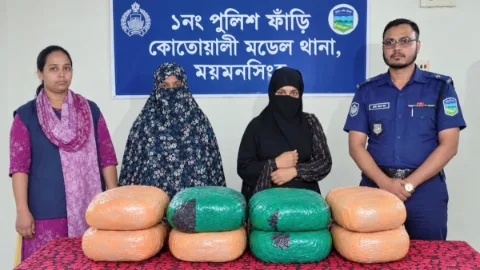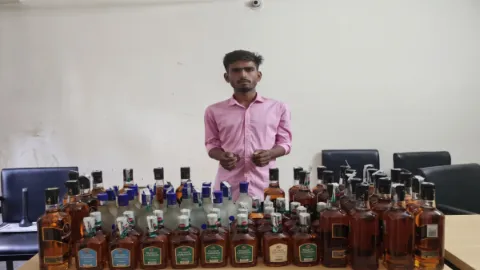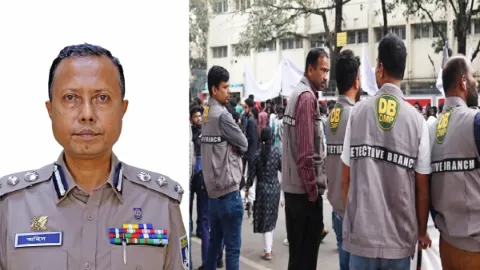
As soon as the winter message arrived, the activity of illegal smugglers along the country's northern and eastern international borders surged at an unusual rate. Using dense fog and harsh weather as a natural shield, smuggling syndicates have become active in Netrokona's Durgapur and Kolmakanda, Mymensingh's Dhobaura and Halua Ghat, and the Sherpur border area. At the same time, through sensitive routes in the eastern regions of Brahmanbaria and Cumilla, illegal and duty‑free Indian goods worth hundreds of crore taka enter the country daily. Ground investigations and on‑the‑spot observations by local residents have revealed a picture of a planned and complex border‑crime network.
Investigations show that during the winter season the smuggling circuit in the hilly rivers of Durgapur and Kolmakanda in Netrokona and the tea‑covered rugged tracks multiplies many times. Most of these mountain routes lack barbed‑wire fencing, and the difficult terrain makes regular patrolling extremely hard. Similarly, in the border‑adjacent areas of Halua Ghat and Dhobaura in Mymensingh, smugglers exploit reduced visibility on winter nights. Through these routes, primarily Indian sugar, cosmetics, high‑value saris, fruits, cigarettes and hazardous chemicals and narcotics are entering the country. Conversely, domestic fertilizer, fuel and valuable metals are being smuggled out across the border.
According to local residents, on winter nights when the surroundings fall silent, piles of goods are carried on the heads or in the bags of hundreds of people across border rivers and mountain streams. Local eyewitnesses claim that the smugglers select their timing in a highly organized manner, choosing the period between midnight and 4 a.m. as safe. Several unnamed local inhabitants say that unemployed youths and teenagers from the area are recruited as carriers on a daily‑wage basis. For a small sum, these young people risk their lives crossing the hazardous mountain passes, while wealthy godfathers remain hidden from public view.
The picture of the eastern border is similarly described by the same sources. Drugs and duty‑evading textiles are entering through unguarded border points such as Kasba and Akhaura in Brahmanbaria and various points in Cumilla. Local awareness groups allege that smugglers exploit road connectivity in the border area to load these goods onto auto‑rickshaws and covered vans and quickly distribute them to district towns. Local residents claim that if the visible presence of security forces does not increase during the winter season, the overall social order in these areas will begin to break down.
A law enforcement official, who declined to disclose the name of the agency, said that there are syndicate guards or linemen at every point on the border. Smugglers on the other side of the border instantly learn the location of the security forces' patrols through technology. He said that when the visibility drops to just a few feet due to fog, the lack of thermal cameras or modern night vision devices becomes apparent. It is a major challenge to keep the vast hilly gorges or dirt roads under constant surveillance through traditional patrols.
According to lawyers related to the court, smuggling is a non-bailable and serious offense under the Special Powers Act 1974. However, the effectiveness of the law often gets stuck due to limitations at the field level. A senior lawyer, who wished to remain anonymous, said that the consignments seized by the police or border security forces mostly show the arrest of ordinary day laborers or drivers. As the real beneficiaries or financiers are not named in the charge sheet, the main culprits do not get caught in the trial process. As a result, the arrested people are released in a short time due to weak evidence and investigation, and they get involved in the same activities again.
Read more: Durgapur border sees ownerless liquor consignments and syndicates in the background
Noted personalities and security analysts demand that to stop border smuggling, it is not enough to just rely on operation-based strategies to get out of this crisis. According to them, it is necessary to immediately set up permanent infrastructure for CCTV cameras, drone surveillance, and modern thermal imaging technology in the unprotected and vulnerable border areas. At the same time, it is necessary to create economic alternatives in the hilly settlements on the border, so that ordinary people are not forced to work as carriers due to poverty. A policy analyst, who declined to disclose his name, mentioned that the only way to resolve this long-term national crisis is to implement a zero-tolerance policy free from political influence at the border and to exchange information with the border security forces of neighboring countries.