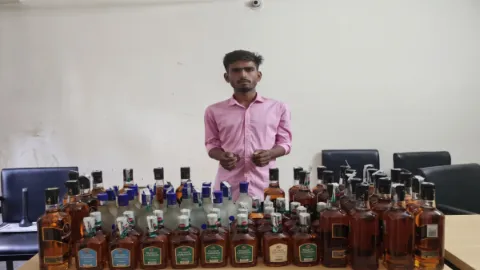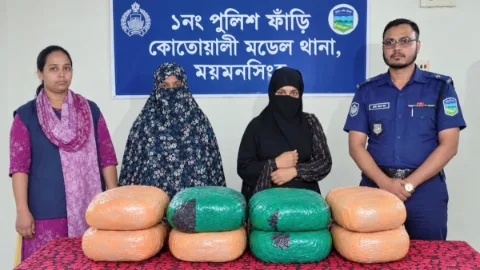
A team of Kotwali Model police station in Mymensingh conducted a special operation at the entrance of the city around 2:30 am on 26 October and arrested two women drug traders along with 16 kg of cannabis. According to police sources, the arrested accused are Majeda Begum of Langura village in Kalomakanda upazila of Netrokona district and Sumita Hajong of Baruakona area in Durgapur upazila of the same district. The accused were sent to jail after a case was filed against them under the Narcotics Control Act at Kotwali Model police station. However, field-level investigations have revealed that this arrest is not just a carrier arrest incident, but rather a well-organized smuggling network in the northern border region is behind it.
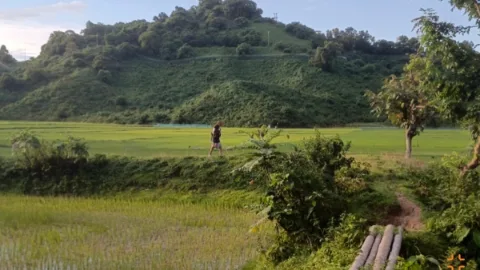
Our special crime monitoring and local correspondents' investigations have found that drug syndicates are using women as carriers or 'carriers' to evade law enforcement. Smugglers are using Netrokona's Durgapur and Kalomakanda, and Mymensingh's Dhobaura and Haluaghata border areas as the main routes. According to social researchers, extreme unemployment, economic crisis of veteran and marginalized communities, and the helplessness of poor ethnic minorities, especially Garo and Hajong communities, in hilly areas are being exploited to engage them in this deadly business for a small amount of money. Experts are of the clear opinion that it is not possible to eradicate drugs just by arresting carriers; it is not possible to stop this smuggling without creating permanent employment in border areas and resolving the unemployment problem.
Read more: Durgapur border sees ownerless liquor consignments and syndicates in the background
According to security analysts and retired military officers, due to international law and constitutional obligations, the opportunity to increase permanent military camps at the zero line of the main border is limited. However, it is now time to set up temporary military camps and joint search checkpoints on the adjacent connecting roads, excluding this restricted area. According to the conscious section, like the security model of the hill regions, it is necessary to ensure thorough scanning and searching of public transport and goods-carrying trucks at every entry point from Durgapur, Kalomakanda, Haluaghata, and Dhobaura to the city. It is urgent to establish specialized police stations and strengthen intelligence surveillance on drug-prone routes beyond the traditional patrols of regular police stations.
Notable individuals and local residents are demanding that holding only the administration responsible for stopping this drug aggression will not be enough; the accountability of local political leadership and public representatives must be ensured first. It is impossible for drugs to enter the city without the direct or indirect shelter and support of the union and ward committees at the grassroots level. Therefore, ensuring the involvement and transparency of local public representatives and bringing the political raghavboalds under the law is the main demand of the people. To save the youth, ensuring employment for the unemployed, conducting strict searches in the hilly style on the border routes, and building a socially resistant system free from political influence are the only solutions now.