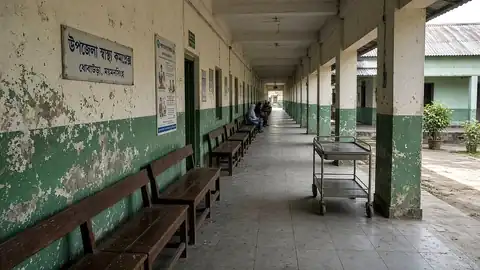
The 50-bed Durgapur upazila health complex in Netrakona's bordering upazila has become a hub of extreme mismanagement and irregularities. Although government documents show that the hospital has more than 50 personnel, including doctors, nurses, and staff, the actual scene is one of dire emptiness. Hundreds of patients come to the hospital for treatment every day, but they cannot find doctors during the scheduled time. This is compounded by the excuse of a crisis of cleaners, a foul-smelling and unhealthy environment, a lack of medicine, abuse by some nurses, and the tyranny of outside clinics and female brokers' syndicates.
The analysis of the government portal's information of Durgapur upazila health complex shows that the hospital currently has a total of 12 doctors (upazila health and family planning officers, residential medical officers, consultants, and medical officers) and 35 nursing officers and midwives (1 nursing supervisor, 30 senior staff nurses, and 4 midwives) registered. In addition, there are at least 8 to 10 other staff, including medical technologists, statisticians, sanitary inspectors, office assistants, and health assistants. However, the government website's employee list lacks specific and updated information about regular cleaners, which highlights the weakness of the hospital's internal management.
According to the health department's government regulations, doctors at the upazila level hospitals must be present in the outpatient department (outdoor) from Saturday to Thursday from 8 am to 2:30 pm. Additionally, emergency and inpatient departments (indoor) must provide 24-hour medical services according to the roster. But in reality, despite having 12 doctors on paper, only 1 or 2 doctors can be found at the workplace; often, there are none. Sometimes, doctors can be seen for a short time in the morning, but patients have to wait for hours; sometimes, doctors are seen as late as 10 pm. A person from the small ethnic group (Hajong community) who came to the hospital for his sister's treatment from a remote hilly area expressed his intense frustration in his native language for not being able to see a doctor on time despite staying at the hospital for three consecutive days.
The same picture is seen in the field of nursing services. Although there are 35 nurses and midwives on the government list, only 4 to 5 nurses are seen performing their duties in the nurse's room on the second floor of the hospital. When asked about the rest, those in charge cite training and various excuses. Additionally, patients and their relatives are dissatisfied with the abuse of duty by some nurses. Veteran citizen Mohammad Ali and a local Hindu woman, who came for treatment, complained that the nurses behave very roughly with the patients.
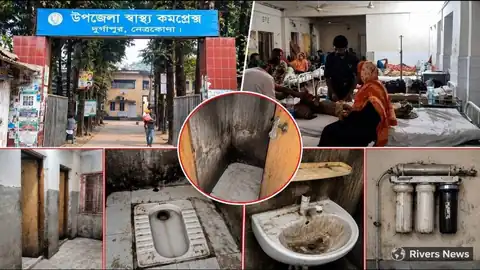
The environment inside the hospital is also extremely unhygienic. Due to the lack of supervision of cleaners, the toilets have a strong stench that can make even healthy people feel sick. Earlier, after a report was published on this issue by Reverse News, the toilets were partially cleaned, but due to the lack of supervision, they have returned to their previous state. Moreover, there is no arrangement for pure drinking water throughout the hospital.
Investigations have revealed that the lack of administrative accountability and an unofficial syndicate are behind the failure to solve this problem and the inability to get doctors on time. Although there are doctors and nurses on paper in this rural hospital, many of them are posted in the district town or elsewhere, and some are absent from their workplaces without following the roster duty. This irregularity has been going on for years due to the lack of strict monitoring of biometric attendance machines and the absence of a strong local monitoring system.
On the other hand, general patients in the hospital are being treated with only paracetamol tablets. All other necessary medicines have to be bought from outside pharmacies at high prices. For pathological tests, patients are exploited by a ring of female brokers. The victims said in the local dialect, 'These women harass us every day.' Several local residents, who did not want to be named, alleged that private clinic owners are forcing patients to get tested at specific clinics, using the influence and muscle of the current ruling party and its leaders. The hospital's service system has been deliberately weakened due to the influence of this powerful ring, according to conscious quarters.
According to the 'Government Servants (Regular Attendance) Rules, 2019' and the 'Disciplinary Rules, 2018', being absent from the workplace or being negligent during office hours (from 8 am to 2:30 pm) is a punishable offense. Additionally, according to the 'Private Medical Institutions (Registration and Control) Ordinance, 1982' and the 'Consumer Rights Protection Act, 2009', dividing patients through a broker ring and forcing them to undergo tests is a criminal offense.
On paper, there are more than 50 personnel, but in reality, people are not getting services and there is an overall irregularity. Despite repeated attempts to contact the official and personal mobile phone numbers of the Durgapur upazila health and family planning officer provided on the government website, the official number could not be reached and the personal number was found busy. The locals who have been affected demanded immediate intervention from the Ministry of Health, the Department of Health, and the Netrokona district administration to ensure strict attendance of hospital staff through biometric means, make the presence of doctors, nurses, and cleaners mandatory at their workplaces, and remove clinics and syndicates of brokers through mobile courts.