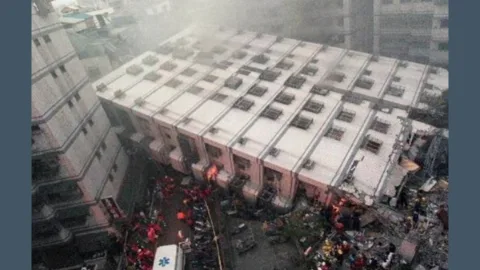
International Desk: China's territory is like a living earthquake laboratory. Recently, a strong earthquake measuring 7.0 on the Richter scale that hit the Nagku region of Tibet has again raised strong questions in the international scientific community. What exactly is going on deep in the soil of the country criss-crossed by the Pacific and Himalayan fault lines? An in-depth investigative report on the ongoing collision of continental plates, the acutely deadly effects of shallow earthquakes, and second-level early alarms to the modern infrastructural struggle for the safety of billions of people.
Why is China shaking again and again: Research by geological experts says that the biggest catalyst behind China's repeated tremors is the historical and continuous collision between the 'Indian Tectonic Plate' and the 'Eurasian Plate'. For billions of years the Indian terrane has been pushing the Eurasian plate northward at a rate of about four to five centimeters per year. Due to this unprecedented tectonic stress, the Himalayas and the vast Tibetan Plateau were formed. But the pressure didn't stop there; The enormous amount of static energy or 'elastic strain' generated by the continuous thrusting of the Indian plate is spread throughout mainland China. When the crust of the Earth cannot withstand this tremendous pressure, massive earthquakes occur.
Read more: The Middle East Crisis: Frontline Realities and Investigative Teams in Search of Durable Solutions
The danger of hidden internal cracks and shallow tremors: Another reason why China's earthquakes are more dangerous to scientists is that they occur not on the ocean's borders, but on "intracontinental fault lines" hundreds of kilometers long inside the country. Active faults such as the Longmenshan, Altin Tagh and Kunlun fault lines are highly sensitive. Added to this is the shallow origin or shallow depth of the earthquake. As most tremors occur only 10 to 25 km below the surface, the seismic waves directly strike the above-ground structures with extreme force, thereby multiplying the level of damage.
Beijing's security shield and modern technology: China has built a multifaceted security ring based on modern technology to prevent this terrible violence of nature. Strict 'seismic building codes' and 'base isolation' technology have been mandated for the construction of high-rise buildings in major cities of the country. This technology uses special shock-absorbers and flexible steel under the building, which isolates the ground vibrations from the main structure of the building and prevents collapse. At the same time, an automatic early warning system has been developed through thousands of high-sensitivity seismic sensors spread across the country. A 'P-wave' signal detected seconds before the deadly 'S-wave' reaches the city makes it possible to automatically stop bullet trains, cut off gas and electricity supplies and send emergency warnings to ordinary people's mobile and TV screens.
Risks in remote areas and future challenges: While this model of modern security has proven effective in megacities, China's mountainous and rural towns remain at greater risk. Centuries-old houses made of weak raw materials in hilly areas are at risk of collapsing in moderate tremors. Apart from this, landslides and artificial lakes caused by the blockage of rivers after the earthquake caused additional disasters in the hill towns. Therefore, researchers in China are now trying to open new horizons such as artificial intelligence (AI) and ionospheric signal analysis in order to predict earthquakes in advance. According to geologists, it is impossible to stop this tectonic battle of the plates; Hence, the only key to survival against this inevitable reality of nature is maximum architectural engineering and technological precautions.