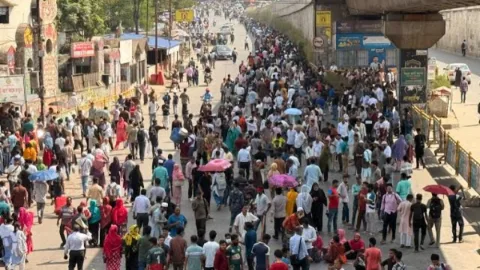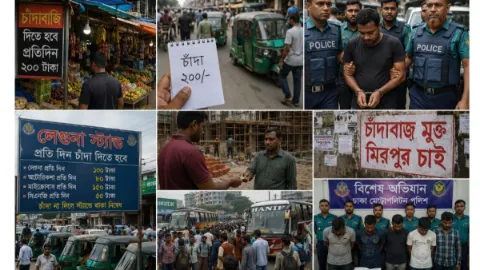
Millions of rupees are exchanged silently every day behind the glitter of the megacity of the capital Dhaka and the busyness of millions of people. From small hawkers on the sidewalks to housing traders in high-rise buildings, public transport or raw markets—no one is spared from this invisible tax. What is ``money'' in layman's terms, in the eyes of criminology is a well-organized 'shadow economy'. Recently, crime-fighting agencies compiled a list of 545 active extortionists in the capital, sparking renewed debate about how deep the roots of this dark empire are.
The history of extortion in Dhaka was not created overnight. Research shows that there has been a huge change in its type in the last few decades. Extortion in Dhaka in the eighties or nineties was mainly based on local 'mastans' or 'gangs'. Then they went directly to the store at gunpoint and snatched money from the cash box.
Since 2000, this type of crime has become institutionalized. Extortion is given a systematic form under the cover of the so-called 'toll' or 'lineman' culture. According to informed circles, a kind of 'three way alliance' between local influential people, political shadow leaders and some unscrupulous members of the law enforcement force is sustaining this crime. No more tolling with sticks on footpaths or transport; This money is withdrawn in a highly professional manner based on digital transactions or daily deposits through specific codes.
Bangladesh's existing law has strict punishments to prevent extortion. But according to prominent legal consultants, some practical complexities and loopholes in the current law allow criminals to get away with it easily.
According to the Penal Code of Bangladesh, 1860 (Penal Code), the main clauses of extortion are:
• Section 383 (Extortion): Extorting money or property by force from a person by intimidation.
• Section 384: General punishment for this offense is imprisonment for a maximum of 3 years or fine, or both.
• Section 385: Threat of grievous hurt or death to any person for the purpose of extortion shall be punishable with imprisonment for a maximum of 2 years.
• Sections 386 to 389: Imprisonment for up to 10 years or life imprisonment depending on the severity of the fear.
Gaps in law and need for amendment:
According to prominent legal consultants, one of the main reasons criminals get away with extortion cases is fear of victims testifying and 'lack of evidence and information'. Many lawyers consider Section 384 of the Penal Code to impose a 3-year jail term as too 'mild' compared to today's well-organized extortion.
Legal experts have urgently demanded some legal reforms or amendments:
1. Non-bailable clause: Converting the offense of extortion into a specifically non-bailable clause.
2. Witness Protection Act: Providing legal guarantees of state security so that victimized small businessmen or common people can testify in court against extortionists without fear.
3. Taking digital evidence: Simplifying the process of using CCTV footage, audio records or digital transaction data as irrefutable evidence in court.
In this regard, representatives of the civil society and conscious circles think that it is impossible to stop extortion forever with only police operations, unless the political and economic beneficiaries behind it can be identified.
Read more: Armed rampage of Ashiq forces in Mirpur
can_unemployment_go_away_will_money_betting_stop_for_ever?_1
can_unemployment_go_away_will_money_betting_stop_for_ever?_2
Key question: Will extortion stop forever if unemployment is eliminated?
A large part of the country's unemployed or pseudo-unemployed youth, who work in the fields of these huge extortion syndicates—that is, those who collect money standing in the sun on the streets—are. Not finding any employment or hoping for quick earnings, they get involved in this world of crime.
So the question arises—if employment in the country is guaranteed and the unemployment problem is permanently solved, will extortion be stopped forever?
can_unemployment_go_away_will_money_betting_stop_for_ever?_3
can_unemployment_go_away_will_money_betting_stop_for_ever?_4
What should the government do: which direction should be taken to eliminate unemployment?
To prevent unemployed young men and women from fueling this crime, the government needs to address some specific and long-term strategic sectors:
Read more: Accused Sultan absconded from custody, accused of neglect of duty
• Expansion of technical and freelancing education: emphasis on IT, coding, graphic design and freelancing-based training rather than traditional general education.
• Collateral-free loans to Small and Medium Enterprises (SMEs): Providing loans to start-ups or small businesses on very easy terms and at low interest rates so that unemployed youth can leave the crime sector and become entrepreneurs.
• Industrialization and employment at the divisional level: To reduce the population pressure on Dhaka, create employment in other divisional and district cities of the country. If job opportunities are created outside Dhaka, the youth will not flock to the capital by stepping into the trap of criminal gangs.
• Modernization of the labor market: ensuring legal and social security for workers in the gig economy (eg: ride sharing, delivery services) and the service sector, so that they do not step into the path of crime.
Conclusion:
Extortion in Dhaka is not just a picture of law and order deterioration, it is a deep social and economic disorder. In addition to strict revision and enforcement of laws, unless the country's vast youth community can be integrated into the mainstream economy through decent employment, there is no way to end these shadow syndicates. Now is the time to take concerted action to ensure public safety and build a healthy economy.