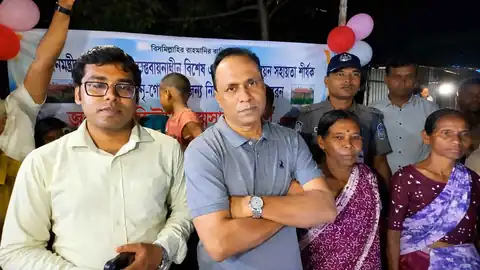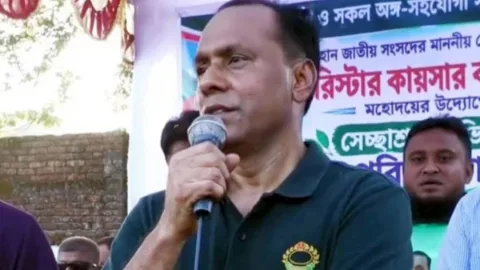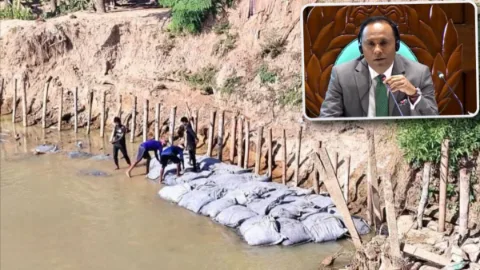
Honorable Deputy Speaker of National Parliament and Member of Parliament for Netrokona-1 Constituency Barrister Kaiser Kamal has once again set a unique humanitarian example. Seeing the desire of a woman named Jamila Khatun, who lost her last possessions due to river erosion in Panishwar Para of Netrokona's Kalmakanda Upazila, she immediately arranged for the allocation of Tk 8 lakh 86 thousand through the Ministry of Water Resources, the work of which has already started.
Honorable Deputy Speaker is not only limited to the development activities of the area, but he is constantly engaged in various humanitarian activities. Before this, he took the full responsibility of the treatment of the child Mukabbir Hossain Rana, who was born with a complex tumor on his head, and took several great initiatives to make him healthy. However, in addition to his admirable humanitarian activities, a big question has arisen in the minds of the conscious community and the general public - will all the humanitarian crises or urgent issues of an area only wait for the single supervision of the Honorable Deputy Speaker?
Read more: Journalist Alif murder: Deputy Speaker's assistance for wife's job in Dhaka
Key Facts and Statement of Barrister Kaiser Kamal Sir:
On September 25, on the way to Batanipara village of Jamdani Palli in Kalmakanda, a 50-year-old woman stopped the car of Honorable Deputy Speaker Barrister Kaiser Kamal when he reached Panishwar Para area. Narrating the incident, he wrote on his Facebook wall:
"Panishwar Para, is the correct name. So all the houses in that neighborhood were lost in the river. On the 25th of September, I went to the village of Batanipara, Jamdani Palli, Kalmakanda. I saw from a distance a woman about 50 years old standing in the middle of the road with her hands raised, the intention was to stop our car. I was a little surprised that even though the car came very close, she did not move. The driver said that the woman might have a mental problem. I stopped the car and got out. And asked why he stood in the middle of the road, there could have been an accident."
After stopping the car, the woman lamented and said that all the houses in the neighborhood have been destroyed by river erosion in the last few years and only this one of their houses has survived. Giving her name as Jamila Khatun, she said, "We live and die the same thing."
After listening to this touching demand, the Honorable Deputy Speaker quickly talked to the concerned officials of the Ministry of Water Resources and arranged for the allocation of Tk 8 lakh 86 thousand and the work started yesterday from October 26. He said, "Trying to save a house, I don't know what's on Jamela's forehead. Like how many poor Khatuns' houses have gone into the river!!"
Read more: Kalmakanda clash over theft, robbery protest leaves one dead
Some of the questions asked by people and relevant:
This immediate action of Honorable Deputy Speaker Barrister Kaiser Kamal is undoubtedly a shining example of humanity. But this incident has questioned the accountability of local politics and leadership at the field level. Common people and conscious citizens of the area are now raising questions in various quarters:
• Question about the role of leaders and activists: Numerous leaders and activists from the grassroots to the middle ranks and local public representatives travel regularly in the area. Why did they not see the sight of all the houses of a neighborhood disappearing under the river for years?
• Lack of responsibility and commitment: Don't local level leaders and officials have minimum commitment and willingness to oversee such humanitarian and public issues on their own?
• Why should a Deputy Speaker do all the work? As a Member of Parliament and Deputy Speaker of the National Parliament, he has to perform national level legislative, policy making and state important duties. In addition to this, he is also looking after a large constituency. But when a common citizen has to stop his car directly to save his last refuge, it is very natural to question the role and activism of the local leaders at the field level.
The clear demand of the people - the grassroots leaders and activists should not limit themselves to political campaigns, but should be sincere in their responsibilities and commitments. Instead of waiting for the personal intervention of the Honorable Deputy Speaker in all crises, the local problems should come up on their own initiative and be solved quickly, that is the demand of the time.